Monday, November 28, 2016

Orb 365 - A Community Art Collaborative with the Lake Superior Ice Festival

Be a part of the 2018 Superior Ice Festival, a celebration of Winter and Water, by contributing to ORB 365! 

Work with your family, friends, school or community group, or as an individual, to contribute to this community art installation by creating ice orbs! 

Each orb represents a day of the year that water is important to us. 


All ice orbs will be arranged into a larger installation on Barker's Island for the  Lake Superior Ice Festival (Jan. 26-28th).

1. Complete and email a pledge form to make ice orbs (crousea@ci.superior.wi.us or 715-394-0392). We will provide all necessary materials and instructions.

Orb365_2.jpg
2. Fill balloons with water and place outside or in a freezer until frozen (2-4 days depending upon air temperature). 

3. Deliver frozen orbs to Barker’s Island on Thursday Jan. 25 between 10:30am-12pm or 4:30-5:30pm (or arrange for pick-up). 

All Orbs must be delivered in frozen form by 5:30 PM on Thursday Jan. 25th.

4. Visit the Lake Superior Ice Festival on Barker’s Island anytime between Jan. 27th-29th to see your contribution to the celebration! Learn more about the event on the Ice Festival website.

Contact Andrea with any questions, for Ice Orb materials, or to arrange for pick up of Orbs: 
       715-394-0392 or email: crousea@ci.superior.wi.us

Download a detailed guide to making Ice Orbs the pledge form, or a poster for the event.


Thursday, September 1, 2016

Lake Superior Needs You!

Lake Superior Needs You!

Lake Superior is our source of drinking water, a place for recreation and relaxation, and a healthy Lake Superior supports many aspects of our local economy. Have fun giving back to the places you care about by joining the Superior Coastal CleanUp

On Saturday September 17th, work alongside thousands of volunteers from around the globe who will be cleaning beaches, rivers, and waterways in their communities on the same day as part of the International Coastal Clean-Up or Great Lakes Adopt-a-Beach programs. 

Gather information about the amount and types of litter found to make positive changes for our lakes, rivers, and oceans beyond the clean-up. The results: cleaner beaches and data on pollution sources that can be used to develop solutions to pollution problems. 

All clean-up supplies, including garbage disposal, are provided.

Who: All are welcome!
When: Saturday, September 17th anytime between 10am and 3pm
Where: Wisconsin Point, Superior WI. Look for the blue registration table at one of the first parking lots on Wisconsin Point Rd
How: Just show up and register at the blue City of Superior table! All clean-up supplies and a data sheet will be provided. 

Or 

Put together your own clean-up team and select a site to clean up that means something to you! You can clean the site anytime during the week of September 12.

Contact Andrea at 715-394-0392 or crousea@ci.superior.wi.us to register your site and get a clean-up kit prior to the event.

Help us keep our Lake Superior!


Monday, April 18, 2016

Spring Cleaning in Superior!

The sun is shining, the snow is disappearing, and the bits of green are popping out. Spring is here! This is a great time to get energized and do some clean up that we may have neglected over the dark winter. Earth Day (Friday, April 22) is also a reminder that we should take actions to clean up our town. Fortunately there are a lot of upcoming events that makes Spring Cleaning much easier!

  • Stream Rescue: Faxon Creek Clean Up 
    • Saturday, April 23, 1-4 pm
    • Meet at intersection of Lamborn Ave and N. 23rd St
    • Hosted by Lake Superior National Estuarine Research Reserve and us (no RSVP required)
  • FREE LANDFILL DAYS 
    • Saturdays, April 23 & April 30, 8am - 2:30pm
    • Bring extra household trash for FREE
    • Spring clean your yard and bring extra brush for FREE. Landfill accepts grass clippings, leaves, and used motor oil FREE year-round
    • NO household hazardous waste (electronics, fluorescent bulbs, etc.)
    • For more information visit: http://www.ci.superior.wi.us/landfill
  •  2016 Annual Spring Cleanup & Annual Brush Cleanup (MAY 2-27)
    • Can't make the Free landfill days? This is a solution
    • Leave eligible materials for pickup at designated time and locations for Spring Cleanup
    • Brush placed on boulevard/streetside of house will also be picked up at designated locations. 
    • Check out the Cleanup and Brush Schedules here: http://www.ci.superior.wi.us/landfill
  • Community Clean Up
    • Saturday, May 14, 9:30-noon
    • Meet at Hammond Park (1920 Hammond Ave.)
    • Contact Tammy Thibert for more info or to sign up (thibertt@ci.superior.wi.us; 715-395-7596)

Thursday, March 3, 2016

Fix a Leak Week (March 14 - 20, 2016)

Fix a Leak Week is approaching! This is a great reminder for people to check their household fixtures for leaks. EPA estimates that household leaks can waste more than 1 trillion gallons of water annually nationwide.
Start checking for leaks by reading your water meter. Read your water meter before and after 2-hour period when no water is being used. If the meter changes at all, you probably have a leak.

There was a case in Superior last year where the water meter wasn't read for over a year. When it finally was read, the property owner found out a toilet was running in the basement for about year. Their water and sewage bills were for using close to 800,000 gallons of water in one month!!

Things to check for:
  • Dripping faucets and showerheads - ensure tight connections to prevent leaks
  • Toilets - over time the rubber part of a toilet flapper decays and may need to be replaced 
  • Irrigation systems should be checked each spring before use 
  • Outdoor spigots and garden hose
If fixtures need to be replaced, look for WaterSense labeled models.
For more information on Fix a Leak visit these websites:
     Wi DNR Fix a Leak Week
     EPA Fix a Leak

Monday, January 4, 2016

ORB 365: A Community Art Installation with the 2016 Lake Superior Ice Festival


Be a part of the Lake Superior Ice Festival, a celebration of Winter and Water, by contributing to ORB 365! 


Work with your family, friends, school or community group, or as an individual, to contribute to this community art installation by creating ice orbs! Each orb represents a day of the year that water is important to us. 

All ice orbs will be arranged into a larger installation on Barker's Island for the closing ceremony of the Lake Superior Ice Festival (Sat. Feb 27th).

1. Complete and email a pledge form to make ice orbs (crousea@ci.superior.wi.us or 715-394-0392). We will provide all necessary materials and instructions.
Orb365_2.jpg

2. Fill balloons with water and place outside until frozen (2-4 days depending upon air temperature). 

3. Deliver frozen orbs to Barker’s Island on Friday Feb. 26 between 10am-12pm (or arrange for pick-up). 

All Orbs must be delivered in frozen form by noon on Friday Feb 26th.

4. Visit the Lake Superior Ice Festival on Barker’s Island anytime between Feb. 20th-27th, and for the closing ceremony on Saturday Feb 27th to see your contribution to the celebration! Learn more about the event on the Ice Festival Facebook Page.

Contact Andrea with any questions, for Ice Orb materials, or to arrange for pick up of Orbs: 
       715-394-0392 or email: crousea@ci.superior.wi.us


Tuesday, December 29, 2015

Salt & Sand Use in the Winter

Winter is Here! We have gotten a few winter storms now and experienced some icy conditions. With that, out comes the salt and sand on pavement to prevent slips and falls. Salt is tried and true way to melt ice and sand adds traction during the really cold conditions. These are great ways to improve safety on roads, sidewalks, driveways, and parking lots, but they do come at a cost . . . to the environment. Sand adds excess sediment to our waters that can smother habitat for aquatic organisms. Salt is a chemical that is toxic to aquatic life at high concentrations. Salt stays in the water virtually forever and can only be removed by reverse osmosis. While we do not discourage the use of salt and sand, we promote the conservative use as to not be harmful to our waterways.

Friendly reminders on salt and sand use:
  • Sand provides traction, does not melt snow and ice
  • Mechanical removal snow is the best way to avoid icy build-ups (salt NOT effective with 3 inches of snow accumulation)
  • Do not apply salt/sand mix. Use salt and salt separately as necessary, depending on condition
  • Salt needs TIME to work (at 15F, one pound of salt needs 60 mins to melt 6 lbs of ice) 
  • Apply sand in extreme cold when salt is ineffective.
  • Salt (Sodium Chloride) is only effective at or above 15F
  • Store salt and sand in a covered container indoors. 
  • When applying salt, go for the pattern below:  

*General rule of thumb for salt use: 1 pound of salt fits into a 12 oz coffee mug and is enough to cover 60-70 feet of sidewalk or 20 feet of driveway. You can always add more salt if needed*
For more info, visit https://www.wisaltwise.com/
Have a safe and happy winter!


Friday, November 20, 2015

Fats, Oils, and Greese!

We are entering the holiday season, hooray! With that comes tasty home-cooked meals prepared with lots of love (i.e. fats and oils from dairy and meat products). Fats, Oils, and Grease (FOG) may add great flavor to our holiday foods, but they are a problem for our sanitary sewer systems. When flushed down the sink, FOG's congeal and build up inside pipes, constricting flow of wastewater. This then leads to unwanted back-ups and overflows of untreated sewage.

Grease is a frequent cause of blocked pipes. Mixing hot water and soap may cause FOG's to "melt" in you sink, it quickly reforms into a solid blockage in pipes.

Prevent FOG Problems by:
x Don't pour oil or grease down the drain
x Don't run water over dishes, pots and pans to wast grease down the drain
x Don't was food scraps down the drain
* Do place cooled fats, oils, and grease into sealed container and discard in the garbage
* Do dry wipe grease from dishes before washing
* Do scrap food scraps from dishes into the garbage can. 
Grease-clogged pipe!
Other plumbing tips for the Holidays: 
  • Avoid putting stringy, fibrous or starchy waste in the garbage disposal. They cannot be sufficiently broken down. 
  • Make sure the disposal is running when you put food into it. Don't wait until it's full to turn it on. 
  • It's a good idea to wait 15 minutes between showers so waste moving through your plumbing has an adequate amount of time to disperse. 
  • Avoid toilet clogs by only flushing human waste and toilet paper . . . nothing else!
  • Know your limits. Often, minor plumbing problems turn into plumbing catastrophes if not handled properly. 
Did you know:  One turkey can produce one pound of waste fats, oils, and grease! 


Friday, September 18, 2015

Celebrate 25 Years of the Pollution Prevention Act!!

This year is exciting since we are celebrating 25 years of the Pollution Prevention Act of 1990. Pollution was such a problem that the Environmental Protection Agency created the Pollution Prevention Act to have pollution prevented or reduced at the source whenever possible. Read about P2 at EPA's website

Pollution Prevention reduces Financial costs (waste management and cleanup) and Environmental costs (health problems, damages). Pollution Prevention not only protects our environment, but also strengthens our community.

September 21 through 27 is Pollution Prevention week!

Here are some Pollution Prevention practices:
  • Use reusable water bottles instead of throw-aways
  • Turning off lights when not in use
  • Repairing leaky faucets and hoses
  • Using non-toxic or "green" cleaners
  • Properly dispose of household hazardous waste (old electronics, paint, etc. SHOULD go to WLSSD)
  • Help clean up litter - any litter on the streets or yard will eventually find its way into a nearby stream
  • Sweep up yard waste - excess grass clippings are pollutants! 
  • Report any illicit discharge/dumping in the City of Superior: http://www.ci.superior.wi.us/illicitdischarge

You can . . .


.

Tuesday, July 21, 2015

The Time is Now!!

Summer is in full swing! The grass is growing, and the trees are full of green. That leads to the problem with yard waste.

The Solution: Compost!! 

Compost is a nutrient-rich soil amendment, created by the natural decomposition of kitchen and yard waste. It is the best and easiest method for getting rid of yard waste as yard waste is BANNED from the landfill.

Compost also reduces water pollution. Organic wastes, such as grass clippings and leaves, contribute to non-point source pollution (that's pollution that enters the waters in diffuse sources, such as runoff from streets). When yard waste decomposes in the water excess nutrients are released and oxygen is depleted. . . making a horrible environment for aquatic life.

Composting is Good!!

Here is the basic formula for making compost:


One of the important things to remember about home composting is that you want to make the critters that do the all work happy. Summer can dry up a compost pile, so it is important to make sure there is moisture in your pile (as wet as a wrung-out sponge). 

Visit our "Composting" tab for more examples of compost ingredients.

Monday, June 8, 2015

Ban the Bead!

On May 22, 2015, the California Assembly passed the world's strongest legislation to ban microbeads. The state would ban not only synthetic particles but the biodegradable plastic as well. Other states - Illinois, New Jersey, Colorado, and Maine - have passed similar laws banning microbeads, but leave loopholes for biodegradable plastics.  

Plastic Microbeads 101:
What are Microbeads?: Microbeads are nasty little bits of plastic smaller than 2 millimeters. They are used frequently in personal care products (toothpaste, soaps, cosmetics, etc.) as exfoliates or for added texture.
Examples of amount of plastic in products

Why should I care?: There is no proven benefit of plastic microbeads in personal care products. There are natural exfoliants (that work better), but plastic microbeads are cheaper for manufacturers. Unlike natural alternatives, plastic microbeads ARE NOT biodegradable and are harmful to the environment.
How are they harmful?: Microbeads are literally microns in size and are NOT removed in our wastewater treatment process. Once in the water, microbeads, like other plastics, can absorb persistent toxic chemicals commonly found in waters across the state and can be mistaken for food by small fish and wildlife.  
What can I do?: Avoid products with these ingredients: polyethylene, polypropylene, polyethylene terephthalate or polymethyl methacrylate.
The good news: Several companies - Proctor & Gamble, Unilever, Colgate-Palmolive, Johnson & Johnson, The Body Shop, and L’Oreal – have all made commitments to phase out the use of microbeads in their products. Many states are working on legislation to ban plastic microbeads. Yay!

Thursday, May 21, 2015

The Story of Sewage in Superior

Go to the Environmental Services Division page

www.ci.superior.wi.us/esd

and click on the History tab to open a page that has a slide show (pdf file) on sewage treatment in the early days of Superior, including when there was over 40,000 people living in town.  In the beginning there was none - no treatment.  Raw sewage regularly went out to local rivers and to Lake Superior.  It wasn't until 1958 that this facility opened.  Improvements in cleaning the wastewater have been added over the years.   The wastewater treatment plant is one big part to help keep local waters clean and healthy for aquatic organisms and for us! 

It was interesting to see the controversy in place and how many people felt a treatment plant wasn't necessary.  

Friday, May 15, 2015

May 19 (Tuesday) program on Water Treatment in Superior (Waste and Drinking Water)

We hope you will attend a program planned for Tuesday, May 19 at 5 p.m. at the Superior Public Library.

Event:   A Closer Look at Water Treatment in Superior, WI
How is it done in Superior?  Drinking Water Treatment and Wastewater Treatment


 We use water everyday.  Water arrives to our homes, schools, and businesses and wastewater will leave from these places.  Attend the approximately one hour program where Superior Water Light & Power will present a closer look at drinking water treatment in Superior and Superior Environmental Services will present about what is done with wastewater to treat it before discharging it back into Superior Bay.   You will also learn about improvements  over the years for better treatment and develop a better understanding on infrastructure in place to have the treatment possible. Finally, you will also take home simple tips on how you can be a part of helping prevent pollution in Lake Superior and conserve water. It would not be a good thing to not have these important services running properly in Superior yet for many decades the services didn’t exist for the early people settling in Superior.   Human health and environmental health are in part connected to proper drinking water treatment and wastewater treatment.  

Any questions?  Call (715)394-0392 or email grethenw@ci.superior.wi.us City of Superior Environmental Services.


Have you been to www.superiorstormwater.blogspot.com lately? 


Visit our Facebook page or Twitter.  SuperiorESDPW


Friday, May 8, 2015

Sludge

What do you think sludge looks like?  The wastewater treatment involves multiple steps to take out materials, including total suspended solids, from the water that will be released into Lake Superior.  It's a Friday and a good day for photos. 

Here are a few:

Here are 4 samples : Influent - what comes into the plant - it's mostly water.
Primary effluent - after treatment through the primary clarifiers
Aeration Basin sample - this is using the activated sludge with lots of organisms
Effluent - is what is released into Lake Superior
 
 
Which sample do you think has the highest TSS (total suspended solids)? 
The correct answer is the Aeration Basin sample.  It would likely have one about 2000 mg/L.  The other values could be about 250 for the influent (note: that sample is looking a bit darker than usual.  It wasn't collected that day), 100 mg/L in the primary effluent and the effluent would be about 10 mg/L.


Here is a view of the Belt Filter Press. The sludge cake are the solids that were concentrated and then removed.  These are what the organisms didn't consume but the organisms do help to greatly reduce the organic materials.   The sludge cake doesn't smell.  It is not of good enough quality to be used on farm fields.  It is trucked the landfill.  Trucks also leave here carrying debris trapped at the screen building and the through the grit chamber. 


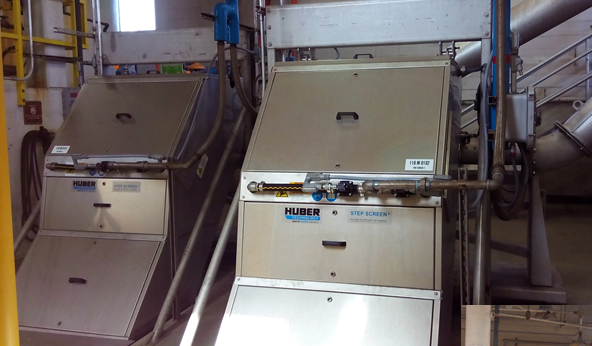
Here are our new Huber Step Screens that were installed this winter. They are shiny and new and do the incredible work of removing materials down to 1/8".  Our previous screens only removed down to 1/4".  We are happy to report they are doing well. 
 
 
Here is an inside look.
With looking closely you can see a goldfish and a bandaid among the debris. 
 
 
Speaking of goldfish.  We do have a goldfish here that we've put in effluent and she is doing fine.  She likes to visit with the students when they come.  Her name is
Sue R. Plant.
 
Remember, the effluent is not drinkable but it's safe for swimming and safe for fish and aquatic organisms.


Monday, April 27, 2015

Wastewater Treatment Tours for Superior students in 5th grade start this week

The warmer weather is here and we're eagerly awaiting Superior's 5th graders to come tour the Wastewater Treatment Plant.   We are glad that Four Corners, Cathedral, Lake Superior, Great Lakes, Cooper and Bryant Schools will be coming over the next few weeks.  The tours will last 2 hours and include and indoor portion where the students will act out wastewater treatment and participate in interactive quizzes about the treatment process and the importance of knowing what not to flush and that stormwater, in most cases in Superior, does NOT come here for treatment but rather flows out to local streams untreated.  The outdoor portion is walking through the steps just as the water would flow arriving here, getting cleaned, and then released out to the Superior bay.
The City of Superior pays for the buses to transport the students to the plant.  We are thankful for the teachers who make time in their busy class schedules to have the students come here to learn more about this process.
As the almost 300 students come through and see the wastewater treatment process they will also learn how to help educate others about what not to flush which will help in preventing pollution to the bay and Lake Superior.  The sights (we have a nice location right on the bay) and smells (really not too bad!) are part of getting to know this important process that is at work 24 hours a day.  A team of over 40 people work here : a mix of engineers, operators, collections crew, administration, educators, and other specialists. 


Can you put the following steps in order? 


If you have a small group of people from your organization, church, workplaces or even neighbors that would like to take a tour, give us a call 715/394-0392. 


Tuesday, April 14, 2015

Scoop the Poop Event Next Week!!!

Get a jump start on Scoop the Poop Week (April 24 - 30)!!!
Come in and make LAWN SIGNS and/or BUTTONS to promote picking up pet waste!
It's a FREE EVENT!! (RSVP at 715-394-0392 or superiorstormwater@gmail.com to ensure we'll have enough materials)
Support Scoop the Poop!! 

When: Tuesday April 21, 2015
            5-7 PM
Where: 51 E 1st St (ESD offices/Wastewater Treatment Plant - across E 2nd & railroad tracks from Golden Inn/Animal Hospital)


Wednesday, April 8, 2015

Copper-free brake pads

Copper-Free Brake Initiative

On January 21, 2015, EPA, states and the automotive industry signed an agreement to reduce the use of copper and other materials in motor vehicle brake pads. The agreement calls for reducing copper in brake pads to less than 5 percent by weight in 2021 and 0.5 percent by 2025.
In addition to copper, this voluntary initiative reduces mercury, lead, cadmium, asbestiform fibers, and chromium-6 salts in motor vehicle brake pads.
The Initiative will decrease runoff of these materials from roads into the nation’s streams, rivers and lakes. Copper from stormwater runoff can affect fish, amphibians, invertebrates and plants.
This initiative includes:
  • Education and outreach to bring about the nationwide reduction in brake pads of copper and the other materials.
  • Testing friction materials and constituents for alternatives.
  • Marking and labeling friction material packaging and product.
  • Providing reporting registrars’ and agents’ contact information to manufacturers, suppliers and other industry entities.
  • Working towards achieving the goals in the Copper-Free Brake Initiative within specified timeframes.
Numbers on copper reductions:
California and Washington already passed requirements to reduce these materials in brake pads. Prior to these requirements, fine dust from vehicular braking released an estimated 1.3 million pounds of copper into California’s environment in 2010 and about 250,000 pounds into Washington’s environment in 2011. Estimates for California show as much as a 61-percent reduction of copper in urban runoff due to changes in brake pad composition.
Co-signers:
In addition to EPA, the Environmental Council of the States and eight industry groups signed the initiative: Motor and Equipment Manufacturers Association; Automotive Aftermarket Suppliers Association; Brake Manufacturers Council; Heavy Duty Manufacturers Association; Auto Care Association; Alliance of Automobile Manufacturers; Association of Global Automakers, Inc.; and the Truck and Engine Manufacturers Association.

The above information is from
http://water.epa.gov/polwaste/npdes/stormwater/copperfreebrakes.cfm

Science Night at UWS is coming up April 10


There will be over 50 booths at this event.  Stop by.  Learning. Prizes. Fun.

Thursday, April 2, 2015

Clean up the Outdoors


Clean Up the Outdoors

The city of Superior Public Works Department has street sweeping April through the fall and the brush pickup is happening in late April.  Sand was applied to roads during the winter time for driving safety.  Now that the snow is mostly gone the sand remains.  The city picks it up and it heads to a temporary site and then to the landfill.   Some cities do not use sand.  However, there are temperatures that salt doesn’t work (too cold) so sand was a way to add traction for safety during those icy times.   We don’t want the sand – or loose soil – to go down storm drains to head to local streams.   Ensure that soil erosion is reduced by having plant roots in place to hold the soil and find ways to reduce the flow of stormwater such as by putting in a rain barrel or having less impervious surfaces.  Water picks up things as it flows over surfaces.  If the surfaces are clean or held in tack it won’t move things.    

There are two free landfill days scheduled  - one on April 25 and the other on May 2.  From 8 AM until 2:30 PM on those days the City of Superior residents can drop off household trash, brush, tires, grass clippings and used motor oil for free.  To drop-off of a mattress you will have to pay $10 each or $13 to drop one off if damp, wet, or heavily soiled.  From the tour we had at the landfill in the fall, about 18,000 mattress are brought to the Superior landfill each year and not very many of them are recycled because they come in wet.  So keep your unwanted mattress dry so that it can go through the program at Goodwill that recycles all the materials. 
  As a reminder recyclables, electronics, appliance, demolition/construction material, batteries, fluorescent bulbs, and household hazardous waste are not accepted at the landfill.  

Also, be sure to pick up pet waste as you walk your dog.  It’s natural material and would ‘go away’ in time but by picking it up you are removing the chance for stormwater to move some of the pet waste and have it travel down a storm drain. 

Finally, inevitably there is litter around.  The wind blew it, the rain moved it, or someone litters on purpose.    Put on a pair of rubber gloves and do some litter pickup for areas in town.  It will be a great way to bring beauty to our city.  Parks, yards, and areas in town will soon have flowers in bloom.  Let’s let the flowers color the lawns and not litter.
 
Enjoy the warmer days and longer days ahead.  Get out and go for a walk.  Admire our local streams and the shore of Lake Superior and bay.  We really do live in a beautiful place.

Monday, March 30, 2015


Over 80 students,  fifth graders from Lake Superior Elementary  and fourth and fifth graders from Four Corners Elementary, attended a Superior Water Fair this morning at the Mariner Mall.  The Water Fair was organized by the City of Superior Environmental Services and included 10 learning stations.  Stations included guests from  Lake Superior Research Institute, Natural Resources Research Institute, Iron River Fish Hatchery, Master Composters, Regional Stormwater Protection Team, Lake Superior Research Institute and community volunteers.    Playing Lake Superior Jeopardy, sorting fish into their micro-habitat hideouts, and calculating water use for the total number of showers per year and the gallons of water saved in a year by a shorter shower, viewing benthic macroinvertebrates, sorting waste into where it should go (medicine to the police station, household hazardous waste to the proper disposal location and recycling, testing water samples for water quality, seeing how rain causes stormwater to pick up pollutants from the land, and learning how a fish hatchery breeds fish and prepares for the stocking of area lakes and learning about aquatic invasive species were all part of the morning’s activities. 

The fair ended with a visit by Adam Clark, meteorologist from KBJR, and he talked the water cycle and forecasting weather.  He also created a cloud in a bottle. 

This is the 3rd year for the fair that has included two schools in Superior at a time. 

Friday, March 20, 2015

Impaired Waterbodies of Wisconsin.

The US EPA has a website that has a searchable database to look up different water bodies in the state of Wisconsin.

The database includes the TMDL (total maximum daily load) for a given material into a waterbody.  Some streams and rivers are impaired due to too much of something entering the system.

Mercury TMDLs are being developed.   Fish advisories are in place.

In our neck of the woods the St. Louis River is the main body of water of concern.