Showing posts with label wastewater treatment. Show all posts

Monday, June 8, 2015

Ban the Bead!

On May 22, 2015, the California Assembly passed the world's strongest legislation to ban microbeads. The state would ban not only synthetic particles but the biodegradable plastic as well. Other states - Illinois, New Jersey, Colorado, and Maine - have passed similar laws banning microbeads, but leave loopholes for biodegradable plastics.  

Plastic Microbeads 101:
What are Microbeads?: Microbeads are nasty little bits of plastic smaller than 2 millimeters. They are used frequently in personal care products (toothpaste, soaps, cosmetics, etc.) as exfoliates or for added texture.
Examples of amount of plastic in products

Why should I care?: There is no proven benefit of plastic microbeads in personal care products. There are natural exfoliants (that work better), but plastic microbeads are cheaper for manufacturers. Unlike natural alternatives, plastic microbeads ARE NOT biodegradable and are harmful to the environment.
How are they harmful?: Microbeads are literally microns in size and are NOT removed in our wastewater treatment process. Once in the water, microbeads, like other plastics, can absorb persistent toxic chemicals commonly found in waters across the state and can be mistaken for food by small fish and wildlife.  
What can I do?: Avoid products with these ingredients: polyethylene, polypropylene, polyethylene terephthalate or polymethyl methacrylate.
The good news: Several companies - Proctor & Gamble, Unilever, Colgate-Palmolive, Johnson & Johnson, The Body Shop, and L’Oreal – have all made commitments to phase out the use of microbeads in their products. Many states are working on legislation to ban plastic microbeads. Yay!

Friday, May 8, 2015

Sludge

What do you think sludge looks like?  The wastewater treatment involves multiple steps to take out materials, including total suspended solids, from the water that will be released into Lake Superior.  It's a Friday and a good day for photos. 

Here are a few:

Here are 4 samples : Influent - what comes into the plant - it's mostly water.
Primary effluent - after treatment through the primary clarifiers
Aeration Basin sample - this is using the activated sludge with lots of organisms
Effluent - is what is released into Lake Superior
 
 
Which sample do you think has the highest TSS (total suspended solids)? 
The correct answer is the Aeration Basin sample.  It would likely have one about 2000 mg/L.  The other values could be about 250 for the influent (note: that sample is looking a bit darker than usual.  It wasn't collected that day), 100 mg/L in the primary effluent and the effluent would be about 10 mg/L.


Here is a view of the Belt Filter Press. The sludge cake are the solids that were concentrated and then removed.  These are what the organisms didn't consume but the organisms do help to greatly reduce the organic materials.   The sludge cake doesn't smell.  It is not of good enough quality to be used on farm fields.  It is trucked the landfill.  Trucks also leave here carrying debris trapped at the screen building and the through the grit chamber. 


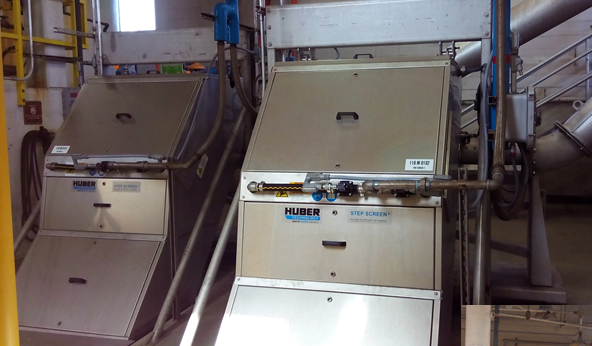
Here are our new Huber Step Screens that were installed this winter. They are shiny and new and do the incredible work of removing materials down to 1/8".  Our previous screens only removed down to 1/4".  We are happy to report they are doing well. 
 
 
Here is an inside look.
With looking closely you can see a goldfish and a bandaid among the debris. 
 
 
Speaking of goldfish.  We do have a goldfish here that we've put in effluent and she is doing fine.  She likes to visit with the students when they come.  Her name is
Sue R. Plant.
 
Remember, the effluent is not drinkable but it's safe for swimming and safe for fish and aquatic organisms.


Friday, July 11, 2014

July 15 and 17 - Storm Drain Stenciling and Wastewater Tour Opp

It's summertime and we have a couple learning opportunities coming up.  It's like school but outdoors and only will be about an hour long.  These would be fine for grandparents and grandkids to participate in.

Tuesday, July 15 at 9 a.m. Meet on the east side of Kelly Park (Grand Ave.) and we will stencil storm drains with the message “Dump no waste, drains to stream.”   Wear old clothes.  Adults and youth above 12 are welcome.  Let us know if you are coming by calling 715-394-0392.  This may be cancelled due to inclement weather.   The project will last about 1 hour.   Cleaning the storm drains and marking them will help keep Lake Superior clean.  
On Thursday, July 17 at 9 a.m. the public is invited to a tour the Superior Wastewater Treatment Plant at 51 E. First St.  We are located one block north (toward the bay) from Superior Animal Hospital.  The tour is outdoors and lasts about 45 minutes.  You will learn how wastewater is treated before it is released into Lake Superior.  You will follow the route that water takes as it has materials removed from it.  You will also learn more about what not to flush to help the system run smoothly.
During the week before Lake Superior Day you’ll also see Lake Superior shape popping up at more places including the windows at Erbert and Gerberts, and Serenity Spa on Tower, and Big Apple Bagels on Belknap.  The painting will be a reminder to think about what you love about Lake Superior.


For more information on Environmental Services news and activities, go to www.ci.superior.wi.us/news or check the ESD Facebook page. 


Lake Superior Day is July 20.  Enjoy music, activities, education booths, rain garden tour, Stand Up Paddleboard demo and more at Barkers Island from 11:30-4 p.m.   A poetry workshop A Sense of Place will be held from 11-noon.  It’s free but advance registration is requested.  The leaders is the WI Poet Laureate Max Garland.  https://docs.google.com/forms/d/1xDFlV7y53_lfM362mvSaUSmtNUSF_8dO1kP53nBfnGw/viewform 

We also have a Water bingo game if you'd like to give it a try.  Words are setup to all be related to water quality, water cycle, and water use.