Showing posts with label fish. Show all posts

Friday, May 8, 2015

Sludge

What do you think sludge looks like?  The wastewater treatment involves multiple steps to take out materials, including total suspended solids, from the water that will be released into Lake Superior.  It's a Friday and a good day for photos. 

Here are a few:

Here are 4 samples : Influent - what comes into the plant - it's mostly water.
Primary effluent - after treatment through the primary clarifiers
Aeration Basin sample - this is using the activated sludge with lots of organisms
Effluent - is what is released into Lake Superior
 
 
Which sample do you think has the highest TSS (total suspended solids)? 
The correct answer is the Aeration Basin sample.  It would likely have one about 2000 mg/L.  The other values could be about 250 for the influent (note: that sample is looking a bit darker than usual.  It wasn't collected that day), 100 mg/L in the primary effluent and the effluent would be about 10 mg/L.


Here is a view of the Belt Filter Press. The sludge cake are the solids that were concentrated and then removed.  These are what the organisms didn't consume but the organisms do help to greatly reduce the organic materials.   The sludge cake doesn't smell.  It is not of good enough quality to be used on farm fields.  It is trucked the landfill.  Trucks also leave here carrying debris trapped at the screen building and the through the grit chamber. 
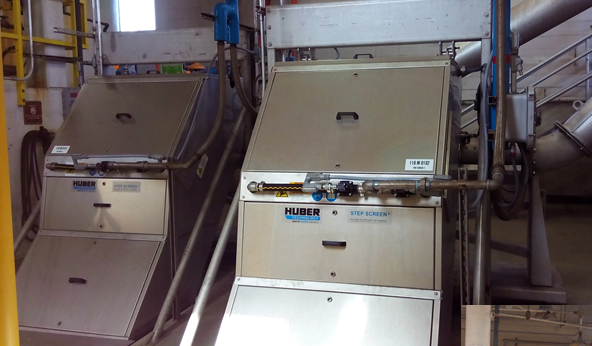


Here are our new Huber Step Screens that were installed this winter. They are shiny and new and do the incredible work of removing materials down to 1/8".  Our previous screens only removed down to 1/4".  We are happy to report they are doing well. 
 
 
Here is an inside look.
With looking closely you can see a goldfish and a bandaid among the debris. 
 
 
Speaking of goldfish.  We do have a goldfish here that we've put in effluent and she is doing fine.  She likes to visit with the students when they come.  Her name is
Sue R. Plant.
 
Remember, the effluent is not drinkable but it's safe for swimming and safe for fish and aquatic organisms.


Monday, May 12, 2014

Mercury reminder

Now that WI's fishing season is a week in, this is a friendly reminder about mercury. Mercury is a toxic metal settles in the environment and turns into organic methyl mercury in our waters. Methyl mercury bioaccumulates up the aquatic food chain. You should be proud of the large walleye you caught during the opener, but reminder that walleye will have a lot more mercury in it than the little trouts you keep catching (General consumption guideline is ONE per MONTH of game fish, unlimited inland trout consumption).

Mercury is in a lot of products such as electrical components and florescent light bulbs. It is really important that when you properly dispose of  mercury-containing products so the toxin will not leach into our environment and get into our fish (can you imagine not being able to catch walleye at all because of elevated mercury risks?). We accept mercury items here at ESD free of charge.

Happy fishing!

Friday, March 28, 2014

Fish & Game Show this Weekend - Stop by our Booth

Stop by our educational booth at the Douglas Co. Fish & Game Show at Wessman Arena.  We'll be doing a short survey and that survey becomes part of an entry to win a FREE CAR WASH.  Thank you to ICO for donating the car wash passes.  By washing your vehicle at a commercial car wash you help keep water quality clean by not washing your car in your driveway where the dirt and soap can go down a storm drain and out to a nearby stream.

Show Hours
Friday 5:00pm-9:00pm
Saturday 10:00am-7:00pm
Sunday 10:00am-4:00pm
FREE PARKING
$7.00 Admission12 & Under FREETicket is good for all three days

Thursday, October 31, 2013

A Very Scary Substance

There’s a scary substance lurking around in the environment.  It’s in the air, water, animals, products we use every day and even in people. It builds up in fish and can ruin their health, too!  When you eat fish with a lot of it in them, you end up with it in you too. It can make people sick and affect neurological development.  What is this eerie element?  It’s mercury, a creepy chemical that’s all around.
Mercury is an element that is liquid at room temperature and evaporates easily.  It occurs naturally, but is most often released into the air through the burning of coal.  It is also used in products like thermostats, thermometers, and switches (like the ones that turn your trunk and hood lights on in your car).  Mercury-containing products are hazardous and should not be thrown in with your regular trash.  You can prevent mercury in the environment by buying products that don’t contain mercury, disposing of mercury-containing items correctly, and becoming more energy efficient.  Watch our webinar below for information on reducing the number of mercury containing items in your life and proper disposal.  You can also tune in for our “Universal Waste Rules for Mercury” webinar on November 13th.  Mercury-containing products can be brought to the wastewater treatment plant (51 E 1st Street) free of charge.  You’ll even receive a mercury-free thermostat.
  
"Mercury and You" webinar from October 8, 2013

Friday, December 7, 2012

Flushing Medications Leads to Not so Healthy Waters

Cold and flu season are well underway through much of the United States.  Many people stock up on decongestants, cough syrup, and pain relievers to get through it.  But what should you do after the illness has passed?  Over-the-counter pharmaceuticals, like prescription medications, have expiration dates after which time their safety and potency is no longer guaranteed by the manufacturer.
If your pharmaceuticals (over-the-counter or prescription) have expired or you no longer need a specific medication, you should know a few things about medication disposal.  First of all, you should never flush pharmaceuticals down the toilet. When you take medications, some of the chemicals are absorbed, but you still excrete some.  Wastewater treatment plants are not specifically equipped to remove pharmaceuticals.  If you flush medications, the excreted chemicals and the flushed chemicals together will both be going to the wastewater treatment plant. So, what happens after wastewater is treated?  It’s released into water bodies with medications still present.  Aquatic life is affected by these chemicals.  Synthetic estrogens, for example, are feminizing male fish.  When we draw our drinking water from these same water bodies, we’re ingesting a mix of people’s medications as well. 
Here are some tips for better disposal:                                                                                      
1.       Take your pharmaceuticals to a take-back event or a pharmaceutical drop box.  These have emerged all over the country and are the best way to dispose of your unwanted, unused, or expired medications.  If you don’t know where to find a drop box or take-back event, try contacting your local police department or pharmacy.  Superior residents, the Superior Police Department now has a drop box, open from 8:00 AM-4:30 PM Monday-Friday.  See here for more information.
2.       Follow instructions given on the original medication packaging.  Do not flush the medication unless the packaging specifically instructs you to do so.
3.       If you do not have access to a drop box or take-back event, you should dissolve pills in water.  You should mix liquids with an undesirable substance like kitty litter or coffee grounds.  After mixing them, the medications should go in an opaque, sealed container in the garbage in order to prevent diversion from your garbage.
For more information:
-Written by Jillian Schubert Edwards